

Original FMN reporting · Christian media
NRB 2026 Brings Christian Media Leaders Together in Nashville
The convention highlighted technology, religious liberty, filmmaking and the changing future of faith-based communications.
FMN AUDIO
Listen to this article
Audio playback is not available in this browser.
Article audio is stopped.
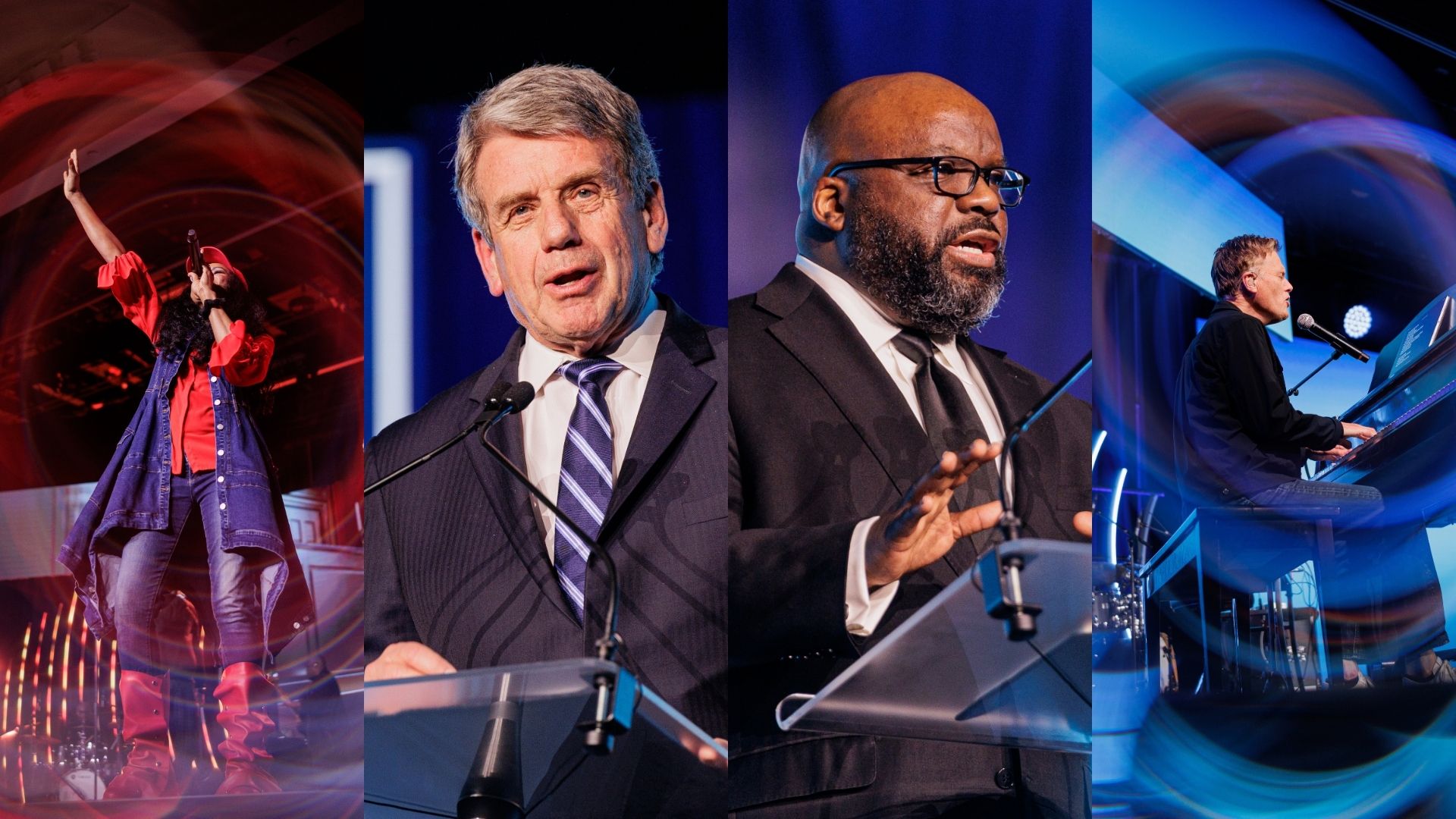
NASHVILLE, Tenn.: Thousands of Christian broadcasters, filmmakers, publishers, podcasters, ministry leaders and digital creators gathered in Nashville earlier this year for the 2026 National Religious Broadcasters International Christian Media Convention.
Held February 17–20 at the Gaylord Opryland Resort & Convention Center, NRB 2026 brought together more than 5,700 Christian media professionals, according to figures released by the organization. That total included 272 international participants representing 43 countries outside the United States.
The convention’s exhibit hall occupied approximately 56,000 square feet and included more than 240 exhibitors working across broadcasting, film, technology, education, publishing and ministry. Organizers described the gathering as one of the world’s largest events dedicated specifically to Christian communications.
For four days, the Gaylord Opryland became a meeting place for established media organizations and a growing generation of independent creators. The schedule included main-stage addresses, worship gatherings, professional workshops, awards programs, film and television pitching opportunities, student competitions and an extensive industry marketplace.
Beyond the formal sessions, the convention’s practical value was visible in conversations among broadcasters, producers, nonprofit leaders and creators comparing tools, discussing partnerships and considering how family-focused audiences can be served more effectively across multiple platforms today.
The convention opened with a direct challenge from NRB President and CEO Troy A. Miller, who urged Christian communicators to participate actively in the culture while remaining grounded in their faith. His message reflected one of the convention’s recurring themes: Christian media organizations must understand the modern communications environment without allowing technology, political pressure or audience growth to compromise their purpose.
That challenge came at a time when nearly every part of the media industry is being reshaped. Traditional broadcasters now share the public square with streaming services, podcasts, social-media personalities, independent news outlets and artificial-intelligence systems capable of producing content at unprecedented speed.
Training for a changing media environment
NRB 2026 responded to those changes with three new training areas devoted to artificial intelligence, new media and church media.
The AI Lab offered 16 sessions covering ethical questions, legal considerations, production workflows, analytics, narrative development and ministry applications. Topics included the use of AI agents, protecting the voices and likenesses of ministry leaders from deepfakes, and maintaining human oversight as organizations adopt automated tools.
These conversations were especially important for churches and ministries that may not have large legal, technical or communications departments. Artificial intelligence can help smaller organizations with administrative work, translation, research and content production, but it also introduces questions involving accuracy, disclosure, copyright, privacy and trust.
The New Media Lab focused on the expanding influence of podcasters, commentators, social-media creators and independent digital outlets. Sessions addressed media training, message discipline, branding and the challenge of communicating clearly in polarized online environments.
Meanwhile, the Church Media Lab offered practical instruction for local congregations. Its sessions explored short-form sermon videos, livestreaming, licensing, staffing and the ways a church’s online presence can shape a family’s first impression before an in-person visit.
Together, the three labs demonstrated that Christian communication is no longer limited to radio towers, television studios or publishing houses. A church volunteer editing a Sunday sermon for social media now operates within the same crowded attention economy as major broadcasters and entertainment companies.
Students, filmmakers and professional connections
NRB’s educational program included more than 100 speakers across keynotes, workshops and panel discussions. Organizers framed the convention as a place where participants could develop practical skills while building relationships with professionals in broadcasting, journalism, film, music and digital ministry.
Students received a place within that professional environment through Intercollegiate National Religious Broadcasters. Participating teams faced timed audio, news, social-media and film-production challenges designed to simulate the pace and pressure of professional media work.
The student program also addressed the relationship between faith and a media career. Sessions encouraged emerging creators to develop technical skills while considering integrity, service and responsibility. For young journalists and filmmakers, the opportunity to meet working professionals can be as valuable as the competition itself.
Film and television remained important parts of the convention. On the final day, NRB hosted its annual Pitch-A-Thon, allowing creators to present projects to industry representatives and explore possible production, distribution and collaboration opportunities.
For independent Christian filmmakers, access to decision-makers is often one of the greatest challenges. Faith-based productions may have strong community support but still need financing, professional development, marketing and distribution. Events such as the Pitch-A-Thon can help shorten the distance between an idea and the companies capable of bringing it to an audience.
Honoring work across Christian communications
NRB 2026 also recognized achievement across Christian communications. The Media Awards Luncheon honored work in digital media, international programming, radio and television. A separate Closing Gala presented the organization’s Special Service Awards.
The recipients included Nancy DeMoss Wolgemuth, Dr. Erwin W. Lutzer, June Hunt, Dr. Robert Jeffress, Pat Boone, Dr. Jack Graham, Terry Meeuwsen, Dr. Randy Weiss and Sadie Robertson Huff. Real Life Ministry received the Billy Graham Award for Excellence in Christian Communications. Charlie Kirk received the President’s Award posthumously.
Wolgemuth, founder and lead Bible teacher of Revive Our Hearts, delivered the keynote message during the Closing Gala. Worship led by Clark Beckham accompanied the evening’s program.
Other major gatherings included the Media Leadership Dinner, featuring Bill Abbott and Shannon Bream; a worship service led by Journey Worship Co. with a message from Samuel Rodriguez; a New Media Reception; and a sold-out Breakfast to Honor Israel.
A newly added Veteran’s Ministry Initiative Luncheon focused attention on ministries serving veterans and military families. The event featured remarks from retired Army officer Allen West.
The convention also presented a Freedom 250 Celebration connected to the 250th anniversary of the United States. The program combined patriotic music, prayer, historical presentations and remarks from religious and political figures. Matthew West led worship during the gathering.
A consequential period for Christian media
Although NRB is widely associated with religious broadcasting, the 2026 convention showed how much broader the field has become. Radio and television remain influential, but they now exist alongside newsletters, streaming platforms, mobile applications, social video, podcasts and emerging AI tools.
That expansion creates opportunities for family- and faith-oriented outlets. It also creates serious responsibilities. Speed cannot replace verification, technology cannot replace editorial judgment, and a religious mission does not eliminate the need for transparency, corrections and professional standards.
The strongest message emerging from Nashville was that Christian media is entering a consequential period. Organizations can now reach audiences without owning a broadcast station or securing a national distribution agreement. A small team with a microphone, camera and digital platform can publish globally.
The question is whether those communicators will combine conviction with accuracy, creativity with accountability, and technological skill with responsible journalism.
NRB 2026 offered its answer through four days of training, worship, networking and professional exchange: Christian communicators should participate confidently in the modern media world, but they must remain clear about the people they serve and the principles guiding their work.
The next NRB International Christian Media Convention is scheduled for February 23–26, 2027, at the Gaylord National Resort & Convention Center near Washington, D.C.